Showing posts with label FLORIDA GOVERNORS LASTING LEGACIES. Show all posts

Wednesday, February 20, 2019

Florida’s Prohibition Governor

An aide once exclaimed to members of the press, "Florida Crackers have only three friends in this world: God Almighty, Sears Roebuck and Sidney Johnston Catts."


   Born on an Alabama plantation in 1863, Sidney Johnston Catts was named after a fallen Confederate general. In 1886, he became awakened by the spiritual and profitable side of the southern Baptist church. As a Born-again pastor, and a controversial figure in history, Catts increased his notoriety by taking advantage of the terrifying spike in racial violence during that decade. Once when a black man threatened him with a knife, Catts killed him with a shotgun blast. This act of violence did little to harm Catts’s political clout among white voters
   When Catts moved to the panhandle, the region was becoming consumed with prohibition, a movement deftly led by the Anti-Saloon League and Woman's Christian Temperance Union, Protestant preachers, and First lady Jennings.  Across Florida and the South, county by county, the drys were crushing the wets at the ballot box. It was an atmosphere that seemed tailor made for a Sidney Catts, and it didn’t take long for this outlandish man to make a stab in politics.
 
A political unknown (His Campaign ad featured on the right) in Florida, he campaigned for the office of governor by walking miles and miles covering Florida with a Bible in one hand and carrying a loaded revolver in the other. He often flamboyantly stood on a stump preaching a political sermon to his supporters while wiping sweat from his ruddy red face with a large handkerchief or cooling himself with a palmetto fan. It is said that he based his political truths on "Religion, Race, and Rum." That is he believed that winning elections in the south was all about traditional religious values, white’s fears about African Americans, and public appearance of being against liquor. As his personal and professional record would later reveal he was not a true believer and only used the movement as an opportunity for advancement.


 Legend has it that what sparked Catts interest in the Governorship was his discovery that once elected, the governor can live in the Executive mansion rent free. His campaign was historic for its use of both an automobile and a loudspeaker which he would use to travel extensively to rural areas. It was in this race that a form of campaigning now referred to as “Barn storming” was born. Catts’ major opponent in the Democratic Primary was state comptroller William Knotts. Catts won the Democratic ticket by a close margin, but Knotts challenged the win in court. Knowing that the courts would back Knotts against him, Catts took to the roads in his Model T in an attempt to turn the race into a populist revolt against the corrupt establishment of state government. The state supreme court ordered a recount and Catts lost by just a few votes.

Infuriated, Catts went to the Florida Prohibition Party leadership and requested their endorsement, which was given. Catts proceeded to trounce the regular Democratic candidate at the general election. On Election Day in 1916, Sidney Catts became the 22nd Governor of Florida with 43% of the vote and the remaining candidates dividing the rest. He was one of only two candidates from the Prohibition Party to ever obtain such a high position in government; the other was Charles Hiram Randall of California, who served in Congress 1915 to 1921. Despite this feat Catts was always a true Democrat


Sidney Catt’s Inauguration was the first ever recorded on film and Catts, a former Pastor, made sure that it was an eventful ceremony. His Inaugural address would layout an agenda that was both anti-Catholic and prejudice, claiming that Pope Benedict XV was secretly trying to take over Florida. The new Governor would later not attend his own Inauguration over his own fear that the punch would be spiked.   He was fine winning as a Prohibitionist candidate. Yet, the second he won, he returned to the Democrats. Despite being a stated defender of sobriety, he shocked many of his most diehard followers by supporting legalized gambling and, his administration was attacked with charges of counterfeiting. In fact during his single four year term, he did nearly nothing for the prohibitionist cause. When it looked like statewide prohibition was going to be a reality, only then did he put his full support behind it.  Once out of the Governor's mansion, Catts for a time established a short-lived business of making patent medicines, such as Catts' Hog Tonic, which was full of booze.
After many long years of battling each other it was the temperance forces that had won the day and the writing was clearly on the wall. Still the brewer and distillers were big business. They spent plenty on money to preserve their operations. Anheuser Busch helped bankroll the United Brewers Association to counter lobby legislators who had been brew beat by the anti-saloon league.  While their efforts may have proved far too little and much too late. The momentum was with a national repeal. Luckily for many brewery owners, they had an ace up their sleeve - smuggling.

Wednesday, February 8, 2017

Dear Jim


Jim Williams was my friend. I can't claim that I was the nearest or the dearest to him. But, we got along very well during the three and a half years we communicated with one another. I would fit our phone interviews awkwardly into lunch hours or breaks during my day job. Whenever I had a day off for a holiday, I would schedule a prolonged interview with him, knowing that he would be at his family's real estate office regardless of the day. We would plan to talk for an hour, it would always turn into two or three. If I needed to get somewhere in the afternoon, I would always get there late. He always made me want to stay on the phone.

We would always stay on the phone for hours chatting, he was so colorful, so open and modest that each conversation was like a marathon deeper into his humanity. He was a farmer, veteran, family man, devoted husband, outstanding citizen, a mentor to me, great conversationalist, and thoughtful public servant. He was state senator during Florida's Golden Age, who once stood up to a Police Chief who attempted to fire a deputy for of all things giving Jim Williams a ticket.  When Dempsey Barron the legendary Senate President tried to manhandle Williams and Bob Graham outside of the senate chambers, ho coldly informed him that "If he ever touched him like that again they were going outside!"

When at a Campaign rally during his first senate race, a jolly Claude Kirk approached him and informed "You're a great guy. But, we're gonna kick your a**!" He smiled at him and told him to bring it on. He was a man who went to war a hawk and who learned to love peace when he earned his Bachelor's degree later in life. He was a furiously loyal friend to Reubin Askew  and the two men had the most caring friendship of any Florida gubernatorial ticket. Trust me on that, I've known a few of them.
He was also blessed with quality that has become rare in politicians, he was kind. Again many politicians try to project kindness, and a lot of them are openly very decent people. But, Jim Williams like Reubin Askew were kind at their core. Decency was marrow deep in them.

When Askew was looking to replace his first Lieutenant Governor, most everyone thought he would ask Bob Graham to be his running mate in 1974. When Askew called Williams to meet him at the Governor's mansion, Williams said no because he had been working all day. The Governor finally got a yes out  of the state senator after it was agreed that Williams didn't have to wear a suit. After losing the democratic primary to Bob Graham, Williams took what he considered the greatest job he ever had in public office, deputy Secretary of Agriculture in the Carter White House.  "I had to have senate approval and I got my own car!" Williams would say with a laugh.

When I told him once I was going to see Carter teach Sunday School he told me to say hi, before mentioning, "He probably won't know who the hell I am."

Jim Williams always looked with amazement that many within his old Senate district looked on Buddy Mackay with such distrust. As some kind of left wing nut. "I'm the freaking liberal!"
And, Yes he was, a shameless Liberal. He grew to dislike the Republican mentality and looked on the tea party with total amusement.  He called himself a "Dove" openly and with total conviction believed in loving your fellow man. He called me his friend and it was an honor that I will always hold dear in my heart. Next only to my Grandfather and Reubin Askew, this man has shaped my political identity.

During what would be our final conversation he talked about how odd it was that he was in his eighties as both his parents died before sixty. He spoke about wanted to throw away all his awards, yet his kids weren't letting him. Being that I have four of my grandpa's awards at my house I told him it wasn't gonna happen. Then I told him about my new book (the one on Jimmy Carter) and he said he was proud of me. In that moment I had a deep respect and admiration for that kind old man, that I didn't think possible. I then had to go pick up my wife from work, as always on a Jim Williams call, I was running late.


Me and the Family in the Wakulla News


<div class="source">KRYSTAL SHEPPARD</div><div class="image-desc">Robert Buccellato with wife Stephanie and son Croston.</div><div class="buy-pic"></div>

Robert Buccellato of Crawfordville is an author, as well as Historian for the Clerk of Court of Leon County.
He has published three books to date, “Florida Governor’s Lasting Legacies,” “Finding Dan McCarty,” and “Jimmy Carter in Plains: The Presidential Hometown.” The latter tells the fascinating and inspiring story of Jimmy Carter’s surprisingly successful campaign and 1976 victory of becoming the 39th President of the United States.
The book describes how growing up in the small town of Plains, Ga., shaped the man, and how together he and his community of supporters, known as the Peanut Brigade, changed the nation through an unprecedented hands on approach to politicking.
It walks you through the presidency, highlighting those things that set Carter apart from presidents before him, such as his position on civil rights and his eventually winning the Nobel Peace Prize.
Buccellato also describes the inevitable changes the town of Plains underwent as a direct result of the influx of tourists and media attention surrounding the campaign and presidency. Much effort went into preserving the small town’s charm despite it’s growth during this period.
The book is not only well written, but it is also artfully illustrated with an array of old photographs to support and enhance the story.
From the moment you meet Buccellato, it is obvious that he has a great appreciation for history.
More importantly, he is a story teller who enthusiastically imparts bits of historical whimsy to anyone who will listen.
When asked what inspired him to write this book or why Jimmy Carter, he generally answers that he was largely influenced by his grandfather, a 20-year legislator in the Florida House of Representatives during the Golden Years of Florida Politics.
However, in a speaking engagement and book signing at the Gwinnett County Public Library in Atlanta earlier this year, he admitted that upon further reflection, the answer actually runs deeper than that. Carter, as a peanut farmer from South Georgia, beat all the odds and became a huge success who “has the ability to make things that seem extraordinarily impossible not only possible, but easy, with hard work and determination,” he says.

<div class="source">KRYSTAL SHEPPARD</div><div class="image-desc"></div><div class="buy-pic"></div>
“And that feeling that you and your community can run, and win, a presidential campaign, is something, I think, that speaks to the best of our system,” Buccellato says. “And it’s still evergreen, this possibility of improving and helping to evolve our system.”
An avid supporter of preserving the “pockets of history across the country, because many have been lost” Buccellato says that upon entering Plains, one sees “miles of hill and tree, people feel they’ve stepped back in time to a lifestyle of day’s past.”
In fact, he has been known to compare Crawfordville to Plains.
When asked about this, he readily offered noteworthy similarities between the two towns. For instance, the old world feel of the 1940s, ‘50s and ‘60s is still present in both places.
In Plains, it’s in the preservation of the old Train Depot that acted as campaign headquarters, largely because it had the only public restroom in town.
Here, the sense of old Florida can be found in the beach bungalows and white sand beaches.
Additionally, both towns have what he described as a detached sense of community, still supporting a feeling of “the leisurely agrarian lifestyle and a freedom from being plugged-in.”
The book mentions that shortly after the election, Plains received its first traffic light.
This brought back memories of growing up in Crawfordville, during a time when there was only one traffic light.

<div class="source">KRYSTAL SHEPPARD</div><div class="image-desc"></div><div class="buy-pic"></div>
Buccellato has been writing since around the age of 12, beginning with fiction and later focusing on non-fiction. Originally from Hollywood, Fla., he moved to the panhandle in 1998.
After attending FSU, he married his wife Stephanie and welcomed their son Croston to the family last year.
In addition to his family, career as historian and numerous book publishing’s, Buccellato manages book signings, radio shows and speaking engagements, as well as a YouTube channel and a Florida history blog.
He is currently working on writing his fourth book, a biography of Jimmy Carter.


here is the link folks
http://www.thewakullanews.com/content/%E2%80%98preserving-pockets-history%E2%80%99

Thursday, April 28, 2016

Florida Squeeze article Finding Dan McCarty


Our good friends at THE FLORIDA SQUEEZE are just too nice
here is a lovely little article they wrote about the book


FindingMcCarty

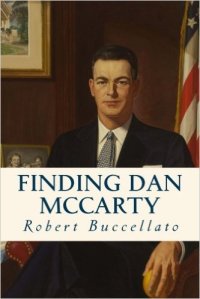
Finding Dan McCarty the new book by Robert Buccellato has been released and is available via Amazon.com (click on the link on the book title to purchase a copy). I’m honored to have contributed to this work writing a Forward which was about the 1940’s, 1950’s and 1960’s in Florida politics.

"A thin layer of glass separated him from the crowd; the endless stream of people walking past his open casket, glancing down at his lifeless face. His body lay resting inches from the main rotunda stairway where just a handful of years earlier he could be seen running up in a mix of energy and youthful vigor that would make him Florida’s youngest speaker and Governor. South Florida’s first Governor, a progressive who was also a realist, McCarty was now stricken by a heart attack. His policies now at the hands of his nemesis, the arch conservative Senate President Charley Johns. But fate and happenstance stepped in and allowed his state to flourish none the less. Finding Dan McCarty is a story about two very different men on similar journeys of personal and professional discovery. On the one hand is an Historian reaching out to the last members of this distant moment in Florida’s history to understand the life of a deceased politician, long hidden under a cloak of mystery. The other is a fallen Governor, who left behind in his wake a lasting legacy of achievement. A story which paints vivid portraits of McCarty’s many enemies, allies, and the historic events that formed the Governor’s thrilling brief life. Written by Robert Buccellato author of the acclaimed “Jimmy Carter in Plains.”

Wednesday, April 27, 2016

Finding Dan McCarty

here is a link to my new book on Governor Daniel McCarty, Florida's 31st governor.


http://www.amazon.com/gp/product/151740553X/ref=crt_ewc_img_ld_1?ie=UTF8&psc=1&smid=ATVPDKIKX0DER


A thin layer of glass separated him from the crowd; the endless stream of people walking past his open casket, glancing down at his lifeless face. His body lay resting inches from the main rotunda stairway where just a handful of years earlier he could be seen running up in a mix of energy and youthful vigor that would make him Florida’s youngest speaker and Governor. South Florida’s first Governor, a progressive who was also a realist, McCarty was now stricken by a heart attack. His policies now at the hands of his nemesis, the arch conservative Senate President Charley Johns. But fate and happenstance stepped in and allowed his state to flourish none the less. Finding Dan McCarty is a story about two very different men on similar journeys of personal and professional discovery. On the one hand is an Historian reaching out to the last members of this distant moment in Florida’s history to understand the life of a deceased politician, long hidden under a cloak of mystery. The other is a fallen Governor, who left behind in his wake a lasting legacy of achievement. A story which paints vivid portraits of McCarty’s many enemies, allies, and the historic events that formed the Governor’s thrilling brief life. Written by Robert Buccellato author of the acclaimed "Jimmy Carter in Plains."

Wednesday, April 13, 2016

Jimmy Carter in Plains: Robert Buccellato valdosta daily news article

“Jimmy Carter in Plains” is mostly a picture book filled with photographs of the 39th President and his family in their Georgia hometown.

Charles W. Plant provides the mother lode of photos. Robert Buccellato provides the words.

The book is part of the Images of Modern America series.

There are plenty of photographs of all of the Carters from the period when he was running for President of the United States: Brother Billy, mother Lillian, wife Rosalynn, etc.

The book reveals Carter’s small-town roots and his outsized ambition to move from the office of Georgia governor to the White House.

Ironically, as the book is filled with Plains photos and remains true to the title “Jimmy Carter in Plains,” the cover is a photograph of Jimmy and Rosalynn Carter walking the streets of Washington, D.C., during the presidential inauguration.

With dozens of photos, the book is an interesting look, literally and figuratively, into the small town that fueled the rise of Jimmy Carter in the 1976 presidential campaign. The same town that serves as his home and inspiration today.

Wednesday, February 3, 2016

Jimmy Carter In Plains : An Amazon bestseller

For the third time since it went on pre-sale
the book has become the #1 New Release in Photography History
It has remained within the top ten all week long and according to the publisher, as sold over half of its first edition. Oh and did I mention the book was only released two days ago.


Get the acclaimed book while you still can, apparently Amazon has had to order another set of books so they won't get sold out.

http://www.amazon.com/Jimmy-Carter-Plains-Images-America/dp/146711541X/ref=sr_1_1?ie=UTF8&qid=1454535253&sr=8-1&keywords=robert+buccellato

Friday, December 11, 2015

Robert Buccellato on the Chris Hahn Show

Based out of New York, the Chris Hahn Radio show is one of the leading Progressive news programs in the nation.
Here is a link to the interview which starts at minute 52

http://christopherhahn.com/

Thursday, December 10, 2015

Fort Lauderdale Magazine


logo.jpg

The October issue of Fort Lauderdale Magazine does my first book Florida Governors Lasting Legacies proud. It cited my book on the great Florida legend and governor Napoleon Bonaparte Broward

HERES THE LINK
http://flmag.com/city-life/guns-muck-yellow-fever

HERES THE TEXT

In the 1880s, he ran munitions for Cuban revolutionaries, running afoul of Spain as well as the U.S. government. He worked on tugs on the St. John’s River before becoming sheriff of Duval County. And later, most famously, he sought to drain the Everglades to develop what he called the “fabulous Muck.”  He had arguably the most bombastic name in a long line of Florida characters. We’re talking none other than Gov. Napoleon Bonaparte Broward, our county’s namesake. His parents not only endowed him with an empirical moniker, but named his brothers Washington Broward (after George, of course) and Pulaski Broward (after the Revolutionary War hero).  His childhood started out very promising, as his parents had a successful farm in Jacksonville. But they  died young, and the Broward clan was on the wrong side in the Civil War. Their original farm was burnt to the ground by Union troops.  Napoleon moved in with an uncle, helped on his farm and earned a high school degree. He traveled north for two years, then returned to Jacksonville.  According to historian Michael Gannon, Broward’s resume grew to include stints as “a riverboat crewman, a Newfoundland cod fisherman, lumberman, a phosphate mine developer, Sheriff of Duval County and a boat pilot.” Those roots explain his path to politics. He wanted to represent the proverbial common man, he said during one campaign: “I don’t intend to go after the cities. Their newspapers are against me and they don’t take me seriously. But I’m going to stump every crossroads village between Fernandina and Pensacola, and talk to the farmers and the crackers, and show them their top ends were meant to be used for something better than hatracks.” He may not have made it to politics if either Spain or the U.S. had caught him running guns to the Cuban revolutionaries on his steamboat-tug The Three Friends. He had several near misses with Spanish gunboats, and the Spanish ambassador, whose country was trying to preserve its tenuous hold on Cuba, demanded he be stopped. The cagey

gv000435.jpg


Broward eluded them all, working under cover of darkness and hiding his vessel behind larger ships, ferrying munitions and explosives picked up in secluded areas along the St. John’s River near Jacksonville. From there, it was to the Bahamas, then to Cuba for the forces of José Martí. When President William McKinley finally declared war on Spain, Broward’s gun-running was no longer needed and he escaped punishment. But his exploits, including a stint in Jacksonville as sheriff during a yellow fever epidemic, added to his stature. One historian notes that during the epidemic he was the only public servant to stay in the city as thousands fled. “He opened his doors to health officials and basically ran the city himself,” writes Robert Buccellato in Florida Governors: Lasting Legacies. In 1900, Broward was elected to the state legislature virtually unopposed. He won the governorship in 1904. The populist Democrat appealed to farmers, laborers and small business, opposing railroad magnates like Henry Flagler and land barons. He is credited with a series of progressive measures passed in the legislature, including reorganizing state colleges into two major universities at Gainesville and Tallahassee, one institution that eventually became Florida A&M, and a school for the deaf. He pushed child labor restrictions, hospital reform and even lobbied the legislature to pass a bill guaranteeing insurance for all state citizens. (The latter bill failed). And of course, there was the draining of the Everglades to provide a new fertile crescent to feed the world (and sell real estate). We know how that ended today as we try to reclaim what we can of the “River of Grass” and live down the reputation of epic land swindles. After his term as governor, he ran and won a seat in the U.S. Senate but died before taking office. But there was a less talked about side to the man who lived in the Florida mansion with his wife, eight daughters and a son, and who got Teddy Roosevelt down here to endorse the Everglades plan. According to T.D. Allman in Finding Florida, The True History of the Sunshine State, Broward was a racist. As governor, he once proposed evicting black citizens from Florida. It was ignored “as an eccentricity” and never went anywhere, writes Allman. But it showed his true stripes (sadly, not all that uncommon in the South then). Allman says he also proposed rules to muzzle the press, who on more than one occasion referred to him as an idiot. “These days his plan for an all-white Florida is completely excluded from accounts of his putative achievements,” Allman writes. In readings from half a dozen books on Florida history, material related to Broward never addressed the race question.  Closest thing I found was a reference to a governor following him by eight years, Sidney Catts, who ran on a platform that was anti-black, anti-liquor and anti-Catholic. He claimed that the nuns were hiding guns in convents and the pope was planning to move the Vatican to Tampa. (Right, of all the world’s cities the pope would certainly choose Tampa.) But if the Vatican never left its mark on Florida, our own Napoleon surely did - See more at: http://flmag.com/city-life/guns-muck-yellow-fever#sthash.bHKfmIx0.dpuf